
Tissue Clocks, Virus Stress Granules, and Sleep-Guided Risk
Aging, infection, cognition, and even well-being don’t live in isolation inside the body—they show up in patterns. This week’s research spans from “tissue clocks” extracted from pathology slides to how cells restructure their defenses during viral infections. Together, the studies highlight a common theme: biology leaves measurable signatures, and careful measurement can help us anticipate risk before it becomes obvious.
Histology’s “Tissue Clocks” Could Track Aging Where It Matters
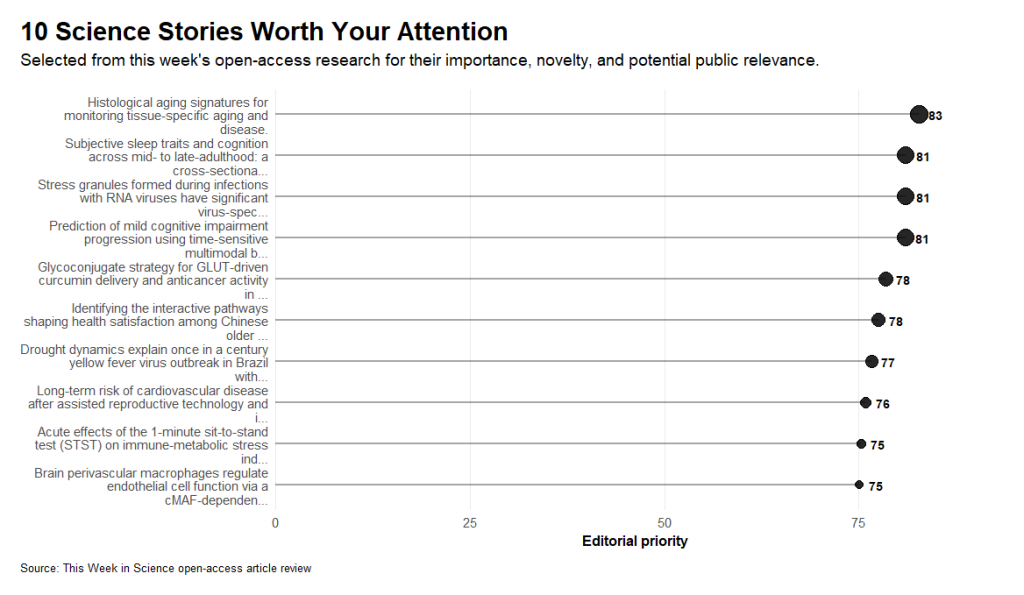
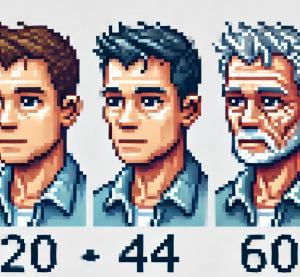
Researchers in Nature Medicine developed a new way to measure how individual tissues age. They analyzed more than 25,000 tissue images from nearly 1,000 people and used deep learning to create “tissue clocks” that estimate biological age based on changes in tissue structure. These estimates were associated with known signs of aging, health conditions, and factors such as lifestyle and medical history. The researchers also developed a method for estimating how quickly specific organs are aging using blood samples. They tested the approach across several diseases, including Alzheimer’s disease, stroke, and Crohn’s disease. The findings suggest that aging does not happen uniformly throughout the body and could eventually help identify organs that are aging faster than expected
Stress Granules Aren’t One-Size-Fits-All in Viral Infections
In PLOS Biology, researchers studied stress granules, structures that form inside cells when they are under stress, including during viral infections. They compared how these structures formed during infections with two different viruses: mouse hepatitis virus, a coronavirus, and Semliki Forest virus, an alphavirus. The researchers found major differences in when the stress granules appeared and which proteins they contained. Semliki Forest virus RNA was also found inside the granules, while mouse hepatitis virus RNA was not. These results suggest that cells do not respond to every viral infection in the same way. Instead, different viruses may trigger distinct cellular stress responses, which could help researchers better understand antiviral defenses and develop new treatments.
Sleep, Genes, and Cognition: Interactions—Not Simple Effects
A study in Sleep examined how sleep, genetic risk for Alzheimer’s disease, and cognitive performance may interact. Researchers analyzed data from nearly 3,900 people, including almost 2,000 pairs of twins. Genetic risk for Alzheimer’s disease by itself explained very little of the differences in cognitive abilities. However, the researchers found that genetic risk may interact with people’s individual environmental experiences, particularly for memory and verbal abilities. Sleep appeared to play only a small role in these relationships. The findings highlight that Alzheimer’s risk and cognitive aging are shaped by complex interactions between genetics and the environments people experience.
Earlier Signals of Alzheimer’s Risk Using Time-Sensitive Multimodal Biomarkers
A study in Science Advances examined whether researchers can predict which older adults will develop mild cognitive impairment before symptoms appear. The study followed 102 cognitively healthy adults with a family history of Alzheimer’s disease for about six years. Researchers combined brain imaging, measurements of brain activity, and blood biomarkers to estimate each person’s risk. Models combining several types of information predicted progression better than demographic and genetic factors alone. Some brain activity patterns were particularly useful for predicting near-term risk, while amyloid buildup became more informative over longer periods. The findings suggest that Alzheimer’s risk markers may provide different information at different stages, potentially improving how early cognitive decline is detected.
Climate Extremes and Public Health: Drought Can Change Yellow Fever Dynamics
Finally, researchers examined how drought may have contributed to a yellow fever outbreak in an urban area of Brazil. Researchers modeled how unusually dry conditions could have pushed forest mosquitoes and nonhuman primates closer to cities in search of water while also increasing mosquito biting. Both changes were needed to explain the outbreak’s timing and size. The researchers also found that combining mosquito control, conservation efforts, and vaccination helped control the outbreak, with vaccination having the strongest effect. The findings show how changing weather conditions can alter disease transmission in unexpected ways and highlight the importance of using multiple strategies to prevent outbreaks.
Bottom line:
Across tissue imaging, cellular defense mechanisms, cognitive risk, and outbreak dynamics, this week’s research keeps pointing to the same reality: health outcomes emerge from complex systems. And in each study, scientists are learning to read those systems through measurable patterns—carefully, quantitatively, and with an eye toward real-world implications.