
Cutting Science, Scaling AI: The High-Stakes Battle for America’s Future
As 2027 approaches (seriously), America finds itself at a crossroads in science and technology funding. On one side, the Trump administration is pushing a heavy budget that slashes funding for federal science agencies by nearly half, sparking uproar among researchers and advocates. On the other, artificial intelligence races forward, backed by record-breaking private investment that promises to reshape industries, healthcare, and education.
Amid these clashing priorities, what does the future hold for U.S. science, space exploration, and the next generation of STEM learners?
Deep Cuts Threaten U.S. Science Leadership
The budget proposal unveiled this April reads like a science dystopia. Agencies like the National Science Foundation (NSF) face a jaw-dropping 54.5% cut, trimming it from $8.8 billion in 2026 to just $4 billion in 2027.
The Environmental Protection Agency (EPA) suffers a similarly brutal blow —> a 52% reduction that would decimate programs fighting climate change, advancing environmental justice, and cleaning up pollution.
The National Institutes of Health (NIH) would lose over 10% of its budget, with entire institutes targeted for elimination. These drastic cuts come alongside a 44% surge in military spending, raising eyebrows about America’s priorities. Critics warn that such slashes are “devastating” and could lead to a catastrophic loss of U.S. competitiveness in science and technology.
NASA, the emblem of American space ambition, is slated for a 23% cut overall and a staggering 47% cut in its science division, the lifeblood of planetary exploration and Earth observation. The Artemis program to return astronauts to the moon by 2028 is still funded, but faces squeezed budgets and a pivot toward cheaper spacecraft rather than tried-and-true systems. This budget blueprint is just a starting point for Congress, which has historically pushed back against Trump’s science cuts. Still, the message is clear: funding for science, health, and the environment is in the crosshairs, while defense dominates.
AI’s Rise: Dollars, Data, and Digital Dreams
While public science budgets shrink, private money for AI startups soars to unparalleled heights. Venture funding for AI companies surged 85% in 2025, smashing previous records and drawing nearly half of all global venture capital into the sector. Early 2026 keeps the momentum blazing, with billion-dollar rounds like Elon Musk’s xAI deal lighting up the landscape. AI’s promise is intoxicating. From personalized medical diagnostics to smarter agriculture and even AI tutors tailored to individual students, proponents envision technologies that vastly amplify human intelligence.
Venture capitalists see AI as the next tectonic shift, akin to the internet boom of the 1990s, creating trillions in new value. Yet experts caution that current AI models, such as ChatGPT and Google’s Gemini, suffer from a critical flaw: they lack “internal embodiment.” Unlike humans, who draw on bodily experiences such as fatigue or thirst to regulate their behavior, AI systems operate without self-awareness or internal states. This can lead to overconfidence, errors, and unpredictable actions.
Neuroscientists argue this missing piece makes AI less safe and trustworthy, suggesting new “dual-embodiment” frameworks that could fundamentally reshape AI’s design. Essentially, AI needs to learn what it feels like to be “tired” or “uncertain” so it can think more like us.
Preparing Tomorrow’s Innovators with Robotics and STEM
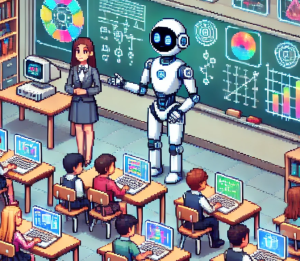
Against this backdrop of budget warfare and AI breakthroughs, classrooms are evolving too. The future-ready STEM education scene is no longer about rote robot building but about igniting deep understanding through hands-on, problem-solving robotics programs. Students today progress from basic coding to mastering sensor feedback and real-world interactions. They learn that failure isn’t a dead end but the launchpad for innovation through debugging and iteration. By connecting robotics to math, science, and even creativity, educators are crafting multidisciplinary lessons that empower students to think systemically. Sensors become their window into cause and effect, while coding gives them the language to command machines.
The goal?
To foster clear thinking and adaptability—skills that will be essential in a world increasingly shaped by AI and automation. Schools face new challenges in matching tool complexity to student readiness, managing infrastructure, and aligning with standards, but the mission to deliver effective robotics education is more vital than ever.
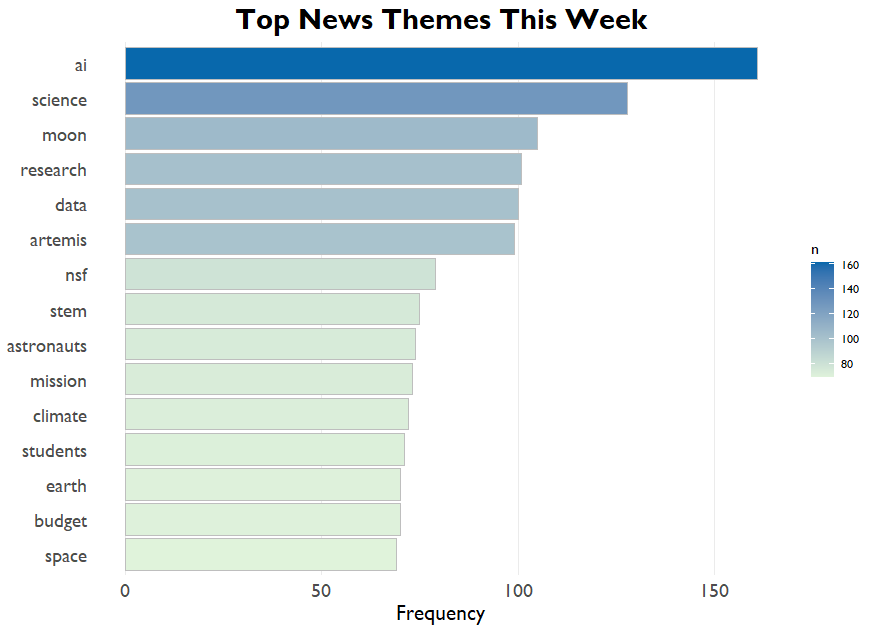
In the swirling mix of deep federal cuts to scientific research and the explosive growth of private AI ventures, America stands at a precarious juncture. Will slashed NSF grants and gutted EPA and NASA programs stunt our scientific leadership? Or will the rapid advances and investment in AI and STEM education fill the gap, ushering in new innovations that keep the U.S. at the forefront?
What’s clear is that the stakes have never been higher. As policymakers, scientists, educators, and innovators debate where to focus resources, the future of our scientific enterprise—and our standing in the global knowledge economy—hangs in the balance. If we fail to nurture research and education while responsibly unleashing the power of AI, we risk a future where technology advances but lacks the wisdom or trust to guide it safely. In 2026, the battle for science, space, and AI is not just policy—it’s destiny.