The Future of Humanity Is Moving
Imagine trying to predict where nearly 11 billion people will live 75 years from now.
It sounds impossible. After all, no one can foresee wars, pandemics, technological breakthroughs, or political upheaval. Yet every few years, demographers at the United Nations release updated population projections that often prove remarkably accurate over the long term. While no forecast is perfect, birth rates, aging, and life expectancy change slowly enough that many of tomorrow’s demographic trends are already visible today.
Those projections suggest something surprising.
The defining population story of the next century may not be how many people inhabit Earth—it may be where they live.
Our analysis of the UN’s 2024 population projections reveals a world undergoing one of the largest demographic redistributions in human history.
Population growth is becoming increasingly concentrated
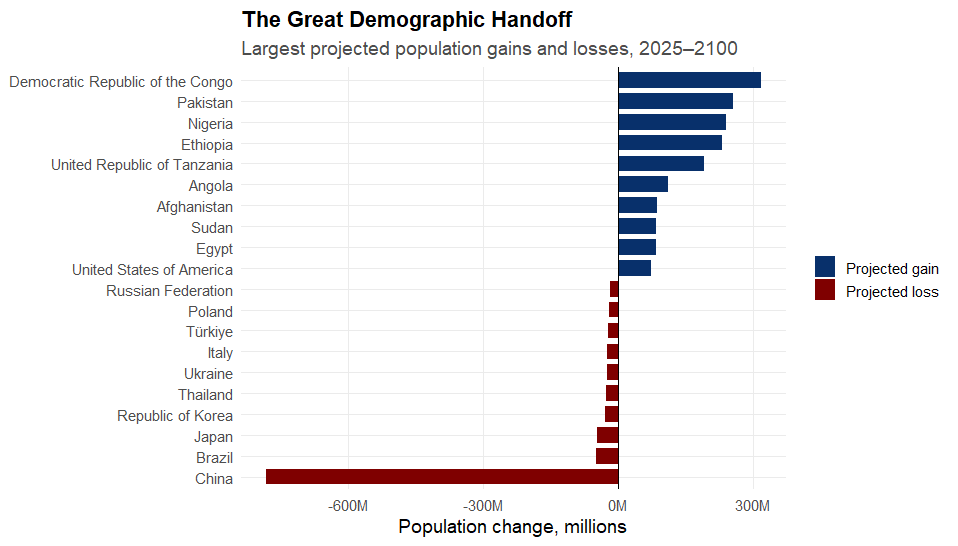
One of the most striking findings is that future population growth is no longer evenly distributed across the globe. The countries projected to add the most people between now and 2100 are remarkably concentrated.
| Country | Population Increase |
|---|---|
| Democratic Republic of the Congo | +318 million |
| Pakistan | +256 million |
| Nigeria | +239 million |
| Ethiopia | +232 million |
| Tanzania | +192 million |
| Angola | +111 million |
Together, these six countries are projected to add well over one billion people by the end of the century.
Meanwhile, population growth across much of Europe and East Asia slows dramatically—or reverses altogether. This is not simply population growth. It is a geographic redistribution of humanity.
The world’s largest countries are no longer guaranteed to stay that way
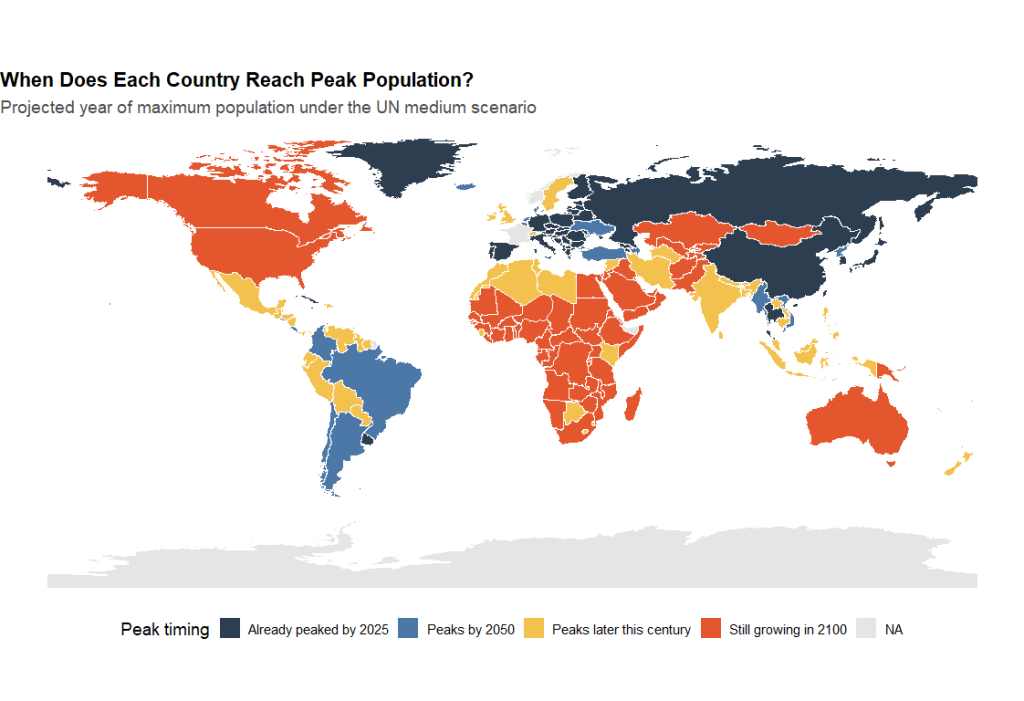
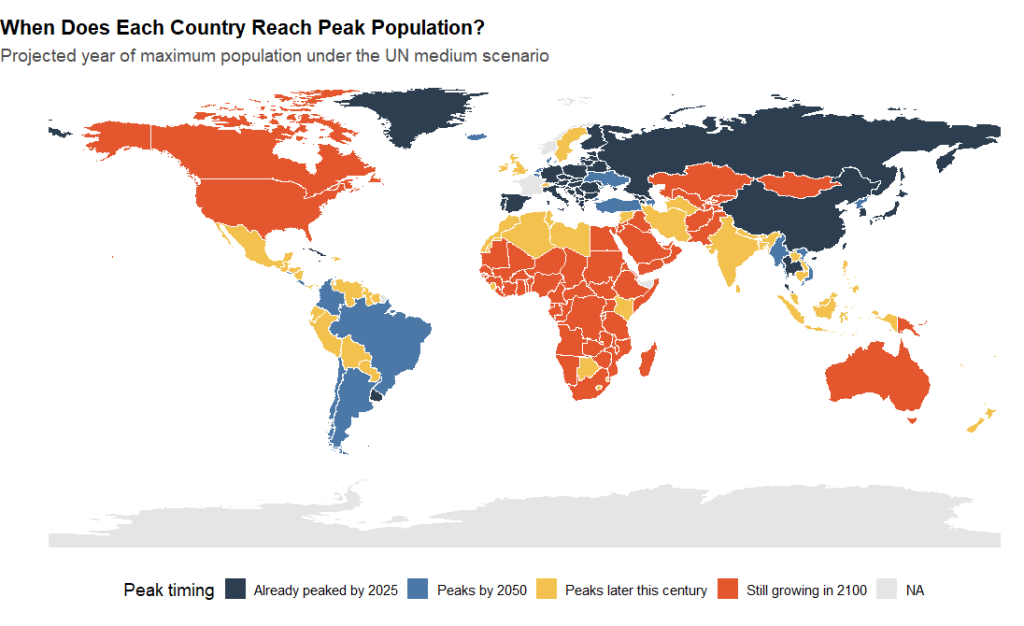
Perhaps the biggest surprise is how many countries have already reached their maximum population.
According to the UN’s medium projection, 60 countries have already peaked by 2025, while more than 100 are expected to reach their maximum population before 2050.
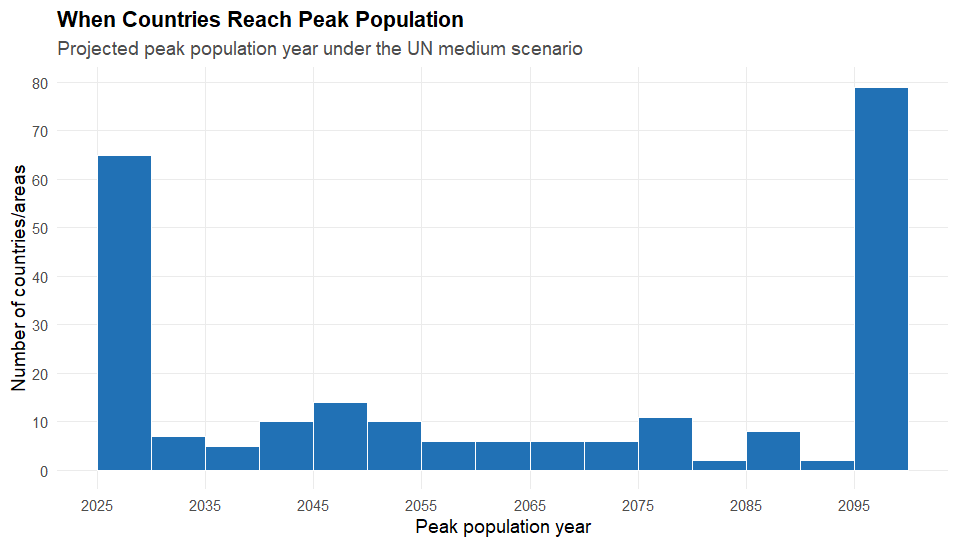
Among them are several of today’s largest economies, including China, Japan, Italy, Poland, and the Republic of Korea. This is a remarkable reversal from the twentieth century, when sustained population growth was often considered the norm.
China’s demographic reversal may be unprecedented
No projection illustrates this transition more dramatically than China.
The UN estimates that China’s population could fall from roughly 1.42 billion today to about 633 million by 2100—a decline of more than 780 million.
To put that into perspective, China is projected to lose more people than currently live in the United States and the European Union combined.
Such a decline would represent one of the largest demographic contractions ever projected for a major civilization.
Meanwhile, Africa becomes increasingly central
While many countries approach demographic stability or decline, another pattern emerges. Many of the fastest-growing countries are located in Africa.
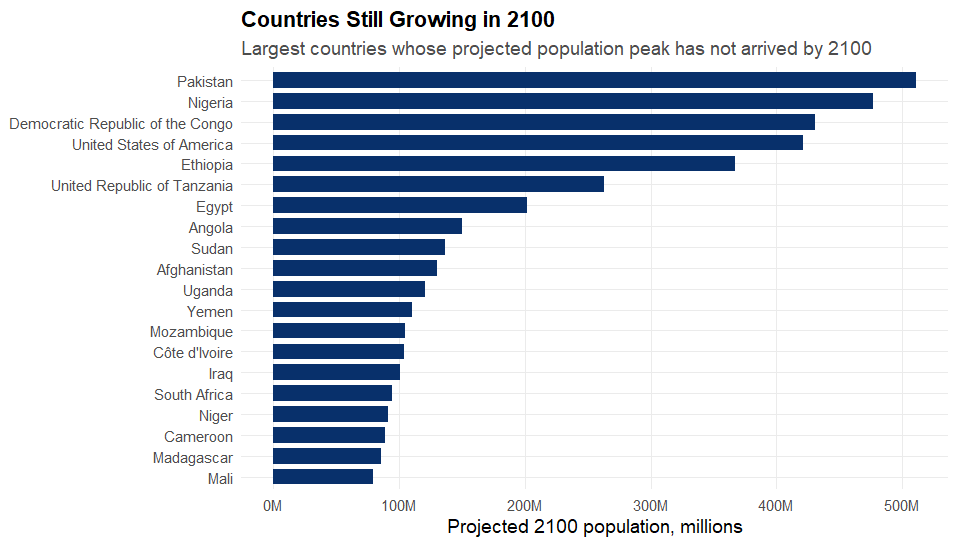
Several—including Angola, the Democratic Republic of the Congo, Tanzania, Somalia, Chad, and the Central African Republic—are projected to more than triple their populations over the coming decades.
Equally notable, ten countries with fewer than 100 million people—including Angola, Sudan, Côte d’Ivoire, Mozambique, Uganda, and Tanzania—are projected to cross the 100-million-person threshold before the century ends.
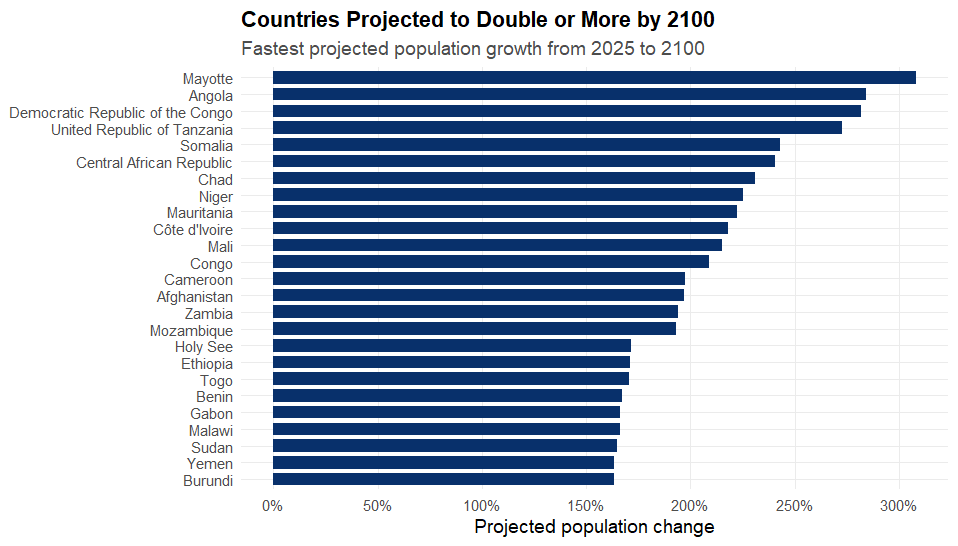
The demographic center of gravity of humanity continues shifting southward.
Science isn’t predicting the future—it is projecting today’s trends
Population projections are often misunderstood as predictions. They are better thought of as carefully modeled scenarios.
Demographers combine observed fertility, mortality, migration, and age structure to estimate what happens if current trends continue under specified assumptions. Because demographic change unfolds over decades, many large-scale shifts can be anticipated long before they become obvious.
That doesn’t mean every number will prove correct. Future conflicts, medical advances, climate change, or migration policies could alter the trajectory.
But the overall pattern emerging from the data is remarkably consistent.
Humanity is entering an era defined less by rapid global population growth than by profound demographic redistribution.
Why this matters
Population isn’t destiny—but it shapes nearly everything. Where people live influences scientific collaboration, economic growth, urbanization, biodiversity, food systems, energy demand, and technological innovation.
The world of 2100 may have roughly the same number of humans that many forecasts anticipate—but they will be distributed very differently from today. The map of humanity is being redrawn, one birth at a time.